
Key takeaways
- What it is: a side-scrolling arcade game by Dong Nguyen, released May 24, 2013. One input, one rule, no ending.
- How to play: tap, click or press Spacebar to flap. One point per pipe pair cleared. One collision ends the run.
- Why it's hard: the flap is a fixed impulse, gravity never stops, and pipe heights are randomized, so there is no rhythm to memorize.
- Is it the original? This reproduces the 2013 game. A different game released in October 2024 uses the name, and its original creator has publicly disavowed it.
- What's here: how to play, controls, technique, and the game's history. Not covered: mobile app downloads, code tutorials, or Flappy Bird spinoffs.
This page is written for anyone who wants to play right now and understand what they're playing, whether you remember the 2014 craze or have never seen it before. Everything below was checked against the game running on this page on August 17, 2026: we played it, pressed every control, and captured the screenshots ourselves rather than describing it from memory.
How to play Flappy Bird
The whole game is one input. Everything else is timing.
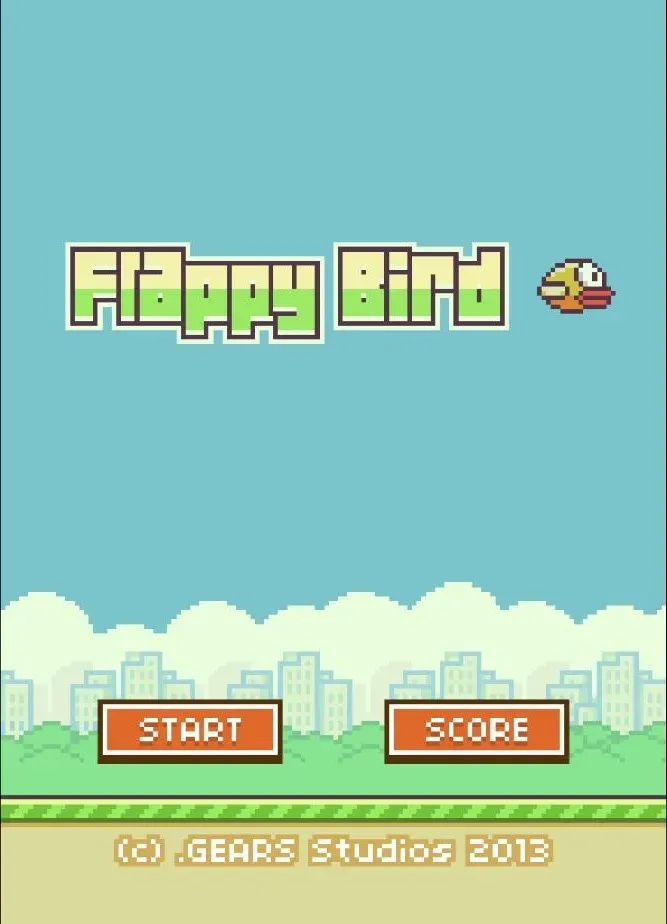
- Press START on the title screen. A "Get Ready" screen appears with a pointing-hand TAP prompt.
- Tap, click or press Spacebar to flap. Each input gives the bird one fixed upward push. Holding the button down does nothing extra.
- Fall between the flaps. Gravity pulls the bird down constantly; your taps are the only thing keeping it up.
- Steer through the gap in each pair of green pipes as they scroll in from the right. The bird moves forward on its own; you only control height.
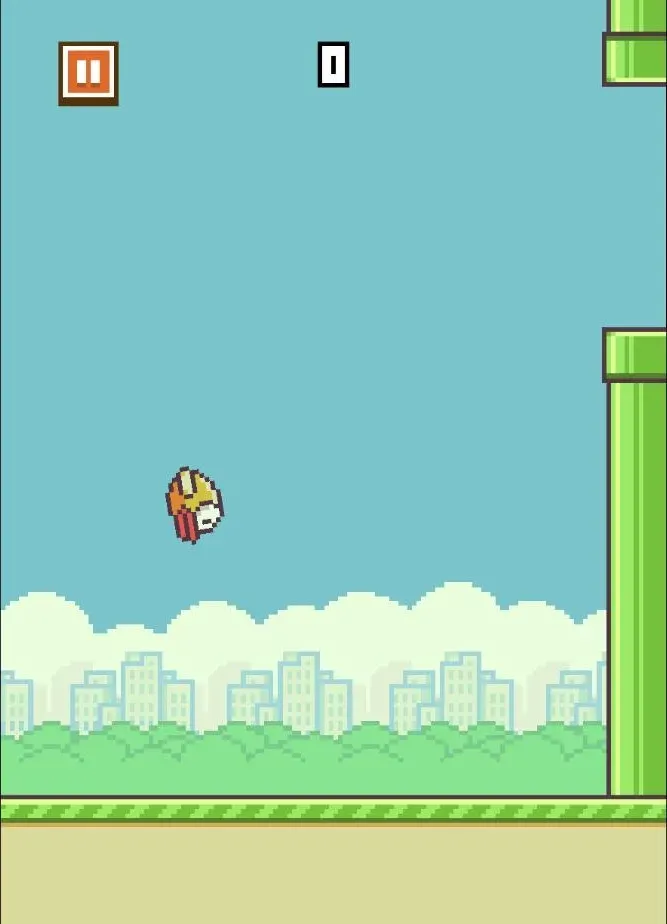
- Score one point per pipe pair cleared. The count sits at the top center of the screen.
- Touch anything and the run ends on a pipe, the ground, the top of the screen. There is no damage, no lives, no second chance.
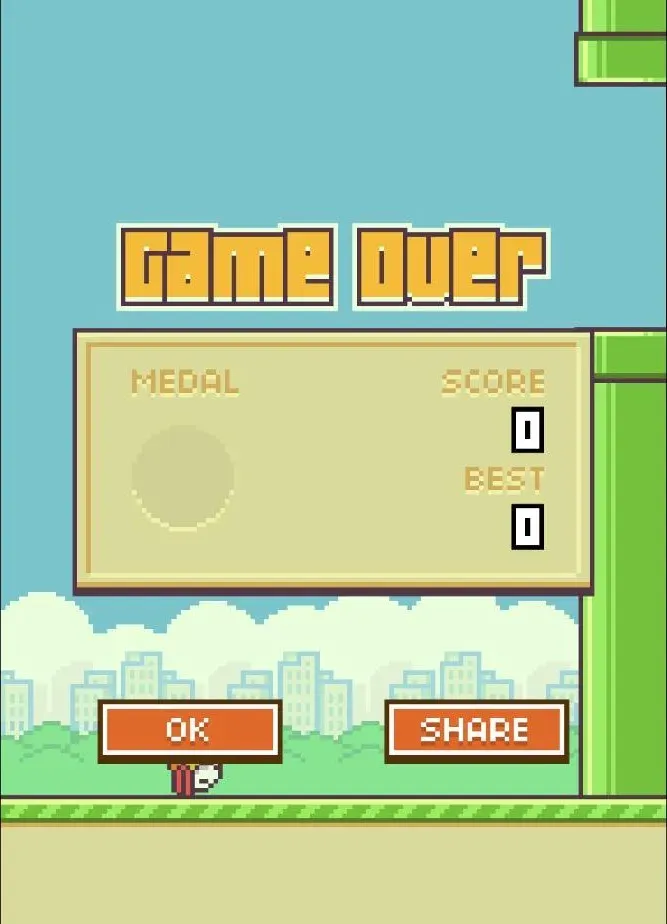
- Press OK on the Game Over card to go straight back in.
Controls
| Device | Flap | Restart |
|---|---|---|
| Desktop — mouse | Left click anywhere on the game | Click OK |
| Desktop — keyboard | Spacebar | Spacebar or click OK |
| Phone / tablet | Tap the screen | Tap OK |
Both the mouse and the Spacebar work in the game embedded on this page; we checked both. There is no separate pause key; a pause button sits in the top-left corner during a run.
Why Flappy Bird is so hard
It is not hard because it is unfair. It is hard because of three design choices that stack:
The flap is a fixed impulse, not a throttle. Every tap applies the same upward burst regardless of how long or how hard you press. You cannot flap "gently" to make a small correction — you get the full jump or nothing, so every adjustment overshoots slightly and has to be corrected again.
Gravity never stops. The bird is always accelerating downward between taps. Wait a beat too long and the bird is not just lower, it is falling faster, and one flap may no longer be enough to recover.
The gap tolerance is narrow and the pipe heights are random. Each new pipe pair sits at a different height, so there is no rhythm to memorize. You are re-solving the same small problem every two seconds with no pattern to fall back on.
Put together, the skill the game actually measures is your ability to hold a steady tap cadence while reading a new target height every couple of seconds. That is why scores climb slowly and then collapse the moment you get tense.
Tips that actually raise your score
These follow from the mechanics above rather than from general encouragement:
- Tap on a steady beat, not in reaction to panic. A regular cadence keeps the bird oscillating in a predictable band. Frantic tapping sends it into the ceiling, which kills runs just as reliably as pipes do.
- Watch the gap you are flying into, not the bird. Your hands already know where the bird is. Your eyes are better spent measuring the next opening. Commit to one focus point and stay there for the whole run, because switching mid-run is where most runs die.
- Arrive slightly below the gap's center. Correcting upward is one tap; correcting downward means waiting for gravity, which takes far longer and is much harder to time.
- Do not flap immediately after clearing a pipe. The most common early crash is hitting the top pipe of the next pair because of a reflex tap taken before the new gap height is visible.
- Restart deliberately. The OK button puts you straight back in, which makes it easy to start a run before you have reset your rhythm. A two-second pause between attempts is worth more than the attempt you skip.
Is this the original Flappy Bird?
This is the one question worth answering carefully, because there are now two different games using the name.
The game on this page reproduces the 2013 original by Vietnamese developer Dong Nguyen: same one-tap flap, same green pipes, same scoring, same title screen crediting .GEARS Studios. That original was pulled from the App Store and Google Play on February 10, 2014, two days after Nguyen announced he was removing it. It has not been officially available as a download since.
A separate game released in late October 2024 also carries the Flappy Bird name. It comes from the Flappy Bird Foundation Group, which was able to use the name after the trademark was transferred to Gametech Holdings on January 12, 2024, when Nguyen did not respond to renewal notices from the US Patent and Trademark Office — the end of a years-long effort to claim the name, as Game File documented. In September 2024, Nguyen publicly stated he has no connection with that game, that he did not sell anything, and that he does not support the cryptocurrency elements researchers found referenced in its builds (reported by TechCrunch, September 15, 2024 and GamesHub).
So: if you are looking for the game people remember from 2014, that is the one running above. If a site tells you that an app-store download is "the original," it is not describing the 2013 game.
A short history of Flappy Bird
Every date and figure in the table below comes from the game's Wikipedia entry, which sources them to contemporary reporting and to Nguyen's own statements.
| Date | What happened |
|---|---|
| May 24, 2013 | Released on iOS by Dong Nguyen under his studio, .Gears |
| January 30, 2014 | Android version released |
| January 2014 | Hits #1 on the free apps charts in the US and Chinese App Stores |
| Early 2014 | Nguyen says the game earns "around $50,000 a day" from in-game ads |
| February 8, 2014 | Nguyen announces on Twitter that he is removing the game |
| February 10, 2014 | Removed from the App Store and Google Play |
| January 12, 2024 | Trademark transferred to Gametech Holdings |
| Late October 2024 | An unrelated game launches under the name; Nguyen disavows it |
Nguyen's stated reason for the removal was not legal pressure, which he denied, and not lack of money. He told Forbes the game "was designed to play in a few minutes when you are relaxed" but "happened to become an addictive product," and said the guilt was costing him sleep. Deleting a game earning roughly $50,000 a day is still, twelve years on, one of the strangest decisions in mobile gaming (Wikipedia).
Flappy Bird unblocked, free, and with nothing to download
The game runs directly in this page, which resolves most of the reasons people go looking for a workaround:
- No download. Nothing installs, and there is no APK to sideload, a practice worth avoiding regardless of which site suggests it.
- No account. No sign-up, no email, no login wall.
- No cost. There is nothing to buy in the game and nothing gated behind a purchase.
- Works on school and work networks where app stores and gaming apps are typically restricted, since this is an ordinary web page.
- Runs on any modern browser — Chrome, Safari, Firefox, Edge — on desktop, phone, tablet, or a Chromebook.
Your best score is saved locally by the game and shows up as BEST on the Game Over card. It is stored in your own browser, so it is personal to that device, and there is no global leaderboard here, and any site claiming a verified Flappy Bird "world record" is not citing a real governing body.
If you want something else after your fiftieth crash, the full game library has other one-more-try arcade games, and the game wiki covers mechanics in more depth.
The short version
Flappy Bird is still the same brutally simple thing it was in 2013: one button, one fixed upward push, constant gravity, and a randomized gap you have to re-read every couple of seconds. It has no ending and no difficulty curve — just your own timing degrading as you get tense. That is the whole design, and it is why a game its own creator deleted twelve years ago still gets played every day.
So: start the game above, tap or press Spacebar, aim slightly below the center of each gap, and keep your cadence steady. Your best score saves locally in your browser. When you're ready to stop crashing into pipes, the full game library is one click away.